Why English-only PG software gets abandoned
Many PG owners have tried software at least once. It gets set up, the first month's rent goes in, and by the third week the warden is back to the notebook. Ask why and the answer is rarely "the app is bad". It is usually "I was not sure which button to press, so I called you." A PG management app in Telugu or Hindi fixes a problem that more features never will: the people who do the daily work have to be comfortable reading it.
Think about who actually touches the records in a typical PG or hostel:
- The warden or manager collects cash, approves UPI screenshots, moves residents between beds and handles complaints. In Hyderabad, many wardens are most at ease in Telugu.
- The cook, cleaners and security get marked present or absent every day, and a few of them may record a payment at the desk. Some read Hindi far more easily than English.
- Residents are students and working people from all over India. Most manage in English, but plenty would rather read their rent and complaints in Hindi or Telugu.
- You, the owner, may want English for reports — or may not.
English-only software asks each of these people to work in their second or third language, with money on the line. Every screen becomes a small test. People who are unsure avoid pressing anything, and a system nobody presses is just a notebook with a monthly fee.
Let each person choose their own language
The common mistake is to pick one language for the whole PG. Your PG is not one language. The owner might want English, the warden Telugu, and a resident who has come from Patna for a job might want Hindi for his rent. Good PG software in a regional language lets each person pick, and shows everyone the same records underneath.
That second part matters as much as the first. A bill of ₹8,500 due on the 5th has to be the same bill in all three languages. When the warden records a cash payment in Telugu and you check it in English that night, you must be looking at the same entry and the same receipt number — not two versions of the truth.
- Owners, managers, staff and residents each pick English, हिंदी or తెలుగు in Settings under App language. The change applies straight away.
- The choice is saved to their own account, so it follows them from their phone to the laptop at the desk.
- Each language is written in its own script in the list, so someone who cannot read English can still find theirs.
- Bills, receipts, balances and complaints are the same records whatever language each person reads them in.
What a hostel app in Hindi or Telugu should look like
A good translation does not read like a government form. It uses the words people say out loud. In StayOne, the Rent tab reads रेंट in Hindi and రెంట్ in Telugu, because that is what residents and wardens actually say. Buttons say what they do, in short everyday words. Here are a few of them as they appear in the app:
| Where you see it | English | हिंदी | తెలుగు |
|---|---|---|---|
| Resident's pay button | Pay & send proof | भुगतान करें और सबूत भेजें | చెల్లించి రుజువు పంపండి |
| Resident's complaints tab | Complaints | शिकायतें | ఫిర్యాదులు |
| Warden's quick action | Collect rent | किराया लें | అద్దె తీసుకోండి |
| Warden's quick action | Check dues | बकाया देखें | బకాయిలు చూడండి |
| Staff attendance | Present / Absent | हाज़िर / गैरहाज़िर | హాజరు / గైర్హాజరు |
| Settings | App language | ऐप की भाषा | యాప్ భాష |
Names, bed numbers and amounts stay as they are — "Bed 112-B" and "₹8,500" read the same to everyone, which is exactly what you want when two people who read different scripts are talking about the same resident.
When you try any PG or hostel app in a regional language, check three things before you decide:
- Coverage: are the screens your staff use every day translated, or only the sign-in page?
- Register: does it use everyday words, or stiff textbook ones nobody says?
- Control: can each person switch on their own, without calling you?
The warden's day, in Telugu or Hindi
Most of a warden's work is the same short list every day. In their own language, each item takes a minute instead of a phone call to the owner:
- Morning: mark the cook, cleaners and security present or absent.
- Through the day: approve the UPI screenshots residents have sent, and give a receipt for any cash.
- Complaints: see what residents have raised, urgent ones first, and close them when they are fixed.
- Move-ins and move-outs: put a new resident on a bed, or settle a deposit when someone leaves.
- Evening: a quick look at who still owes this month.
None of this needs English. It needs clear buttons in a language the warden reads without thinking, and the confidence that a wrong tap can be put right. For how attendance turns into salary at month end, see our guide to PG staff attendance and salary.
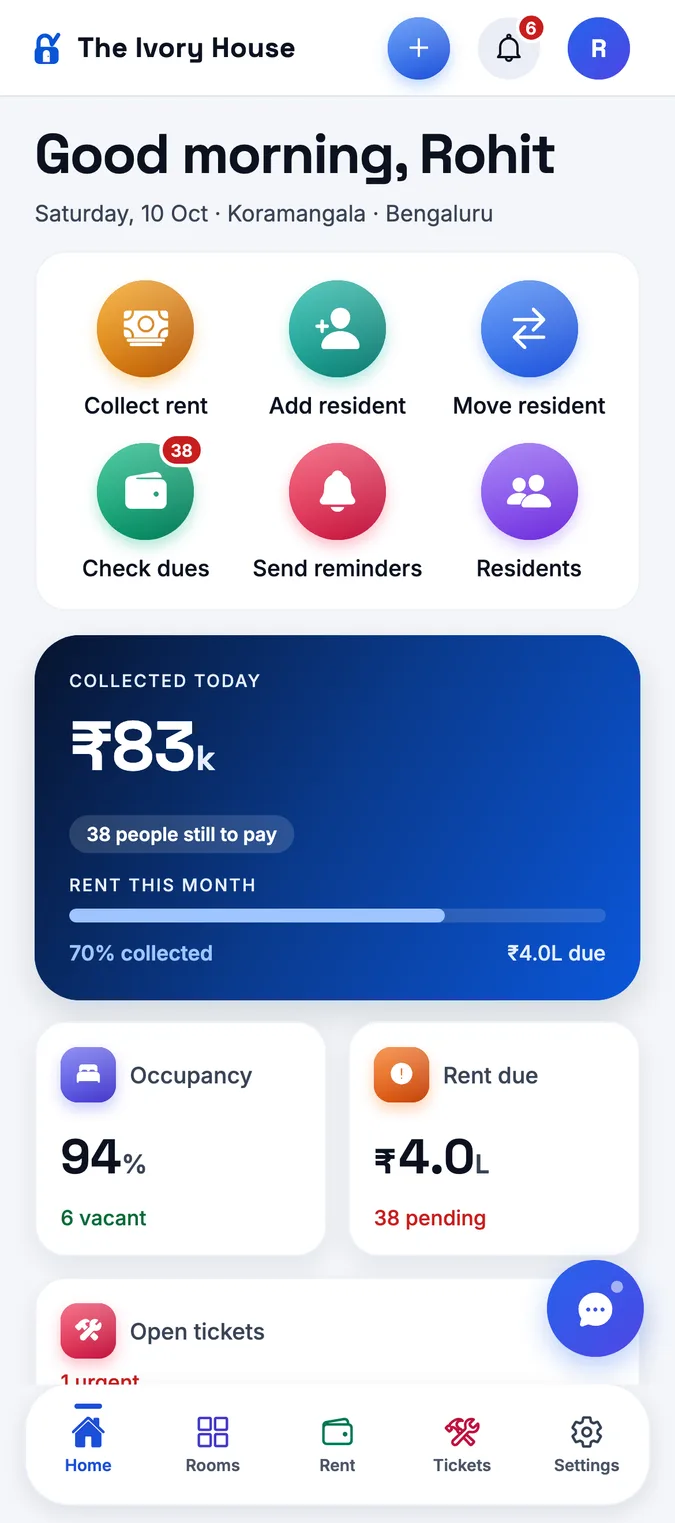
The manager's Home screen keeps Collect rent, Add resident, Move resident, Check dues and Send reminders one tap away, in the manager's own language. Mistakes are not final: owners and managers can undo collections, move-ins, move-outs and refunds at any time, and a reversed receipt is marked reversed, never deleted.
Rent and complaints in the resident's own language
A resident who can read their bill in their own language asks fewer questions. They can see the amount, the due date and what it covers without stopping the warden in the corridor to have it explained. Fewer "how much do I owe?" conversations means fewer disputes later.
Complaints work the same way. A resident who has to describe a broken geyser in English may just mention it to the warden on the stairs, where it is forgotten by evening. When the complaints screen is in a language they read comfortably, raising it in the app becomes the easy option — and a complaint in the app is tracked until it is fixed. Our guide to handling PG complaints and maintenance covers what to do once it arrives.
- The resident's Pay screen shows what they owe, the due date and your UPI details. They pay to your own account — StayOne never holds your money — and send the screenshot for your manager to approve.
- Complaints are raised from the resident's phone, urgent ones come first for the warden, and each stays open until it is resolved.
- Residents change the language themselves, so nobody at the desk has to set it up for them.
What stays in the language you type
Software translates its own screens. It does not translate what people type into it. In StayOne, as in any PG software, these appear exactly as they were written:
- Notices you send to all residents
- The mess menu
- House rules and your PG's details
- The text of a complaint a resident writes
- Names of people and rooms
So write with your readers in mind. For anything important — a water cut, a rent increase, a change in gate timings — put English and Telugu or Hindi in the same notice, one after the other. Keep the sentences short and write dates and amounts in numbers, which everyone reads the same way.
If a line in the app itself has not been translated yet, StayOne shows it in English rather than as a broken word or a code. If you spot one your staff trip over, tell us.
Getting staff who are "not app people" to use it
Language removes the biggest barrier, but people still need a gentle start. This is the plan we have seen work in practice, whatever software you choose:
| When | What to do |
|---|---|
| Day 1 | Sit with the warden. Set the language on their own phone, sign them in with their mobile number and 6-digit PIN, and show only three screens: Home, Rent and Complaints. |
| Days 2–7 | Keep the notebook going alongside the app. Spend five minutes each evening checking that the two match. |
| First Bill all | Do it together. Show the warden how undo works, so the fear of a wrong tap goes away. |
| Week 2 | Stop the notebook. UPI approvals and cash receipts happen only in the app from now on. |
| Residents | Put the join-by-QR poster at the gate, and send a notice — in two languages — saying they can switch the app's language in Settings. |
| Month end | Ask the warden what was confusing. Fix the process, not just the person. |
If your records are still in a register or a spreadsheet, our guide to moving your PG from Excel to an app covers bringing residents over without retyping them.
StayOne is made in Hyderabad, and it works on the Android phones your staff already carry — from Google Play, or in any phone browser. When the warden can read every button, the app stops being the owner's project and becomes the way the PG runs.